Asset Management Software Australia
Asset Management Software for Complete Asset Lifecycle Management
Track, manage and maintain equipment, facilities, vehicles, IT assets, property and critical infrastructure from one centralised platform. Pinnacle Asset Management Software gives Australian organisations real-time visibility and control throughout the complete asset lifecycle.
From acquisition and commissioning through maintenance, depreciation, replacement and disposal, Pinnacle helps you maximise asset performance, reduce downtime, improve compliance and make better asset investment decisions.
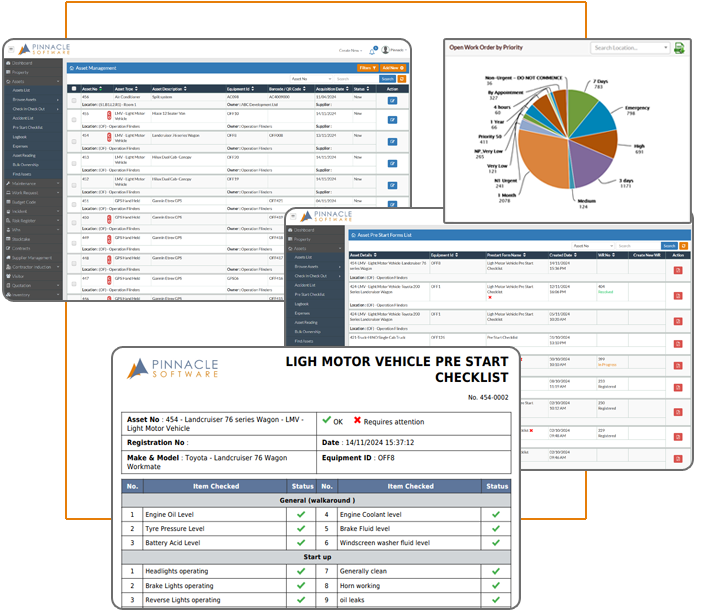
Manage the complete asset lifecycle
- Centralised asset register
- Barcode and QR asset tracking
- Maintenance and work order history
- Warranty and contract records
- Condition assessments and inspections
- Depreciation and financial history
- Lifecycle costing and replacement forecasting
- Mobile field updates and stocktakes
- Multi-site asset management
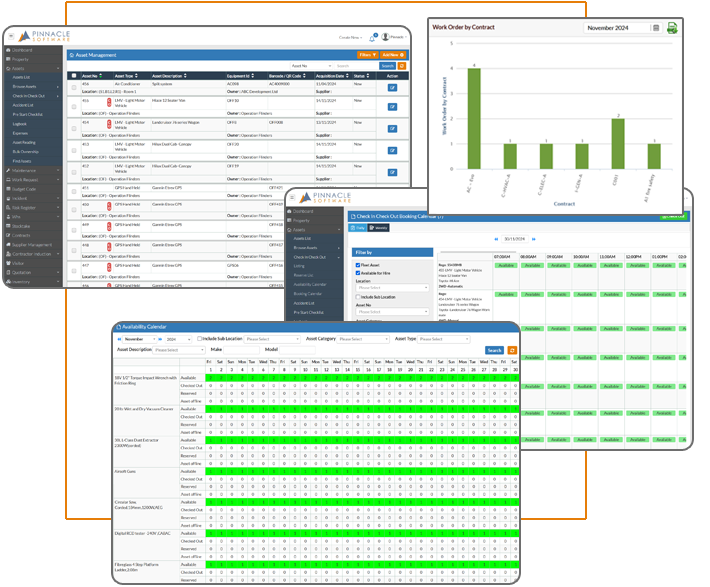
Take Control of Your Assets with One Powerful Platform
Pinnacle combines asset tracking, maintenance management and lifecycle costing in one integrated solution. Record and manage unlimited assets, monitor condition, track maintenance history, manage warranties and contracts, and maintain a complete audit trail of asset activity.
Track Every Asset
Maintain specifications, serial numbers, locations, custodians, cost centres and asset hierarchies in one central register.
Manage the Lifecycle
Control acquisition, commissioning, maintenance, condition, replacement planning and disposal.
Improve Reliability
Use maintenance history, MTBF, MTTR and downtime information to identify underperforming assets.
Control Lifecycle Costs
Track maintenance costs, depreciation, revaluations, remaining life and replacement forecasts.
Asset Management Software Features
Pinnacle provides deep asset lifecycle functionality while connecting naturally with dedicated tracking, maintenance, inventory and compliance workflows.
Asset Register & Tracking
Manage all asset information from a centralised asset register.
- Asset hierarchy and tree view
- Advanced search and filtering
- Barcode asset tracking
- User-defined asset types
- Parent-child relationships
- Asset loans and hire management
- Custodian, location and cost centre tracking
Asset Lifecycle Management
Manage assets from acquisition through to disposal.
- Acquisition history
- Disposals and retirements
- Warranty management
- Condition assessments
- Replacement forecasting
- Rotable asset management
- Spare parts tracking
Financial Asset Management & Lifecycle Costing
Maintain complete financial visibility of every asset.
- Asset costing and financial history
- Revaluations and adjustments
- Depreciation management
- Remaining life and WDV calculations
- Lifecycle costing
Asset Components & Systems
Track complex assets and equipment structures.
- Unlimited component tracking
- Component serial numbers
- Component cost tracking
- Functional system grouping
- Equipment structures and hierarchies
- Component history reporting
Maintenance & CMMS Integration
Connect asset information directly with maintenance operations.
- Work order integration
- Maintenance history
- Labour and cost tracking
- Planned maintenance schedules
- MTBF and MTTR
- Downtime reporting
- Asset performance monitoring
Mobile & Field Operations
Support field teams with real-time access to asset information.
- Mobile inspections
- Barcode scanning
- Condition assessments
- Field updates
- Photo and document attachments
- Real-time synchronisation
Documents & Compliance
Keep important asset information and evidence in one place.
- Document management
- Images and drawings
- Certificates and registrations
- Compliance records
- Permit management
- Unlimited file attachments
Reporting & Business Intelligence
Turn asset data into actionable insight.
- Advanced filtering and search
- Custom reporting
- Asset performance reporting
- Financial reporting
- Lifecycle costing
- Replacement planning
- Asset utilisation analysis
Asset Allocation & Reservations
Support allocation, booking and accountability for shared assets.
- Asset allocation
- Reservations and bookings
- Custodian assignment
- Loan history
- Availability visibility
Asset Tracking Made Simple
Improve asset visibility and accountability using barcode and QR code tracking. Quickly identify, locate and update assets using mobile devices, reducing lost equipment and improving audit accuracy. For broader location, movement and custodian tracking, see our dedicated Asset Tracking Software.
Barcode & QR Tracking
Identify assets quickly and access the correct record from supported mobile devices.
Location & Custodian
Keep asset location, assigned custodian and organisational ownership visible.
Multi-Site Register
Maintain one accurate asset register across facilities, branches and operational sites.
Improve Asset Performance with Real-Time KPIs
Monitor performance and make informed decisions using reporting and analytics across maintenance, utilisation, downtime, costs and replacement planning.
Why Choose Pinnacle Asset Management Software?
Trusted by Australian organisations since 1984, Pinnacle helps businesses, councils, healthcare providers, schools and facility managers improve asset visibility, reduce maintenance costs and maximise asset performance through integrated asset management and maintenance capabilities.
Centralised Asset Register
Bring specifications, documents, ownership, condition, costs and lifecycle history into one source of truth.
Integrated Maintenance
Connect assets with work orders, maintenance history, labour, parts and reliability KPIs.
Multi-Site Visibility
Manage assets consistently across multiple locations with cloud and mobile access.
Financial Visibility
Track depreciation, revaluations, lifecycle costs and replacement requirements.
Compliance Records
Keep inspections, certificates, registrations, permits and evidence attached to the asset.
Connected Solutions
Extend the platform with Inventory Management Software, Fleet Management Software and Test & Tag Software.
Frequently Asked Questions About Asset Management Software
Asset management software helps organisations track, manage, maintain, and report on physical assets throughout their lifecycle, from acquisition to disposal. It improves asset visibility, reduces downtime, controls costs, and supports better decision-making.
An asset register is a central repository containing detailed information about an organisation's assets, including location, condition, ownership, maintenance history, and financial data.
An effective asset register should include asset descriptions, serial numbers, locations, custodians, purchase details, warranties, condition ratings, maintenance history, and supporting documentation.
Asset tracking focuses on knowing where assets are located and who is responsible for them. Asset management covers the complete lifecycle, including maintenance, inspections, condition assessments, depreciation, compliance, and replacement planning.
Asset management software can track buildings, infrastructure, plant and equipment, vehicles, machinery, tools, furniture, IT equipment, signage, and other valuable assets.
Asset management software is used by facilities managers, maintenance teams, councils, schools, hospitals, utilities, mining operations, manufacturers, property managers, government agencies, and asset-intensive organisations.
The software supports organisations across government, local councils, healthcare, education, utilities, mining, facilities management, transport, property management, manufacturing, infrastructure, aged care, and many other industries.
Yes. Assets can be managed across multiple sites, facilities, regions, departments, and business units within a single centralised platform.
Yes. Assets can be tracked by site, location, department, cost centre, custodian, status, condition, and other user-defined categories.
Asset records typically include asset number, serial number, location, custodian, purchase details, warranty information, condition assessments, maintenance history, photographs, and attached documents.
Yes. Barcode technology can be used for asset identification, stocktakes, inspections, audits, and asset movement tracking, helping improve accuracy and efficiency.
Users can inspect, audit, relocate, and update asset information directly from a mobile device, with data synchronised back to the central asset register.
Yes. Mobile devices and barcode scanning can streamline asset verification, audits, stocktakes, and condition assessments while reducing manual data entry.
Audit frequency depends on organisational requirements, risk levels, and compliance obligations. Many organisations conduct annual audits, while critical assets may require more frequent inspections.
Yes. Asset location tracking, movement history, custodian assignments, and regular audits help reduce asset loss and improve accountability.
An asset condition assessment evaluates an asset's physical condition, performance, and risk to determine maintenance requirements, remaining life, and replacement priorities.
The system allows organisations to record condition ratings, defects, inspection findings, comments, photographs, and recommendations against individual assets, creating a complete condition history.
Yes. Inspectors can conduct field inspections using a mobile app to record condition data, capture photos, identify defects, and update asset records in real time.
Yes. Digital inspection forms eliminate paper-based processes and allow users to collect inspection data directly on mobile devices.
Yes. Inspectors can attach photos directly to asset records to provide visual evidence of defects, deterioration, completed work, and asset condition.
Inspections can capture condition ratings, defects, risk observations, measurements, maintenance requirements, notes, photographs, GPS locations, and recommended actions.
Yes. Inspection findings can identify defects and maintenance requirements that can be used to initiate corrective maintenance activities and work orders.
Mobile inspections reduce administration, eliminate duplicate data entry, improve data accuracy, and provide immediate access to up-to-date asset information.
Yes. Organisations can tailor inspection forms, condition rating scales, assessment criteria, and asset-specific checklists to suit their operational requirements.
Yes. All inspections and condition assessments can be retained against the asset, providing a complete historical record and audit trail.
Yes. Inspection teams can perform assessments across multiple locations while maintaining a single centralised asset register.
Regular condition assessments help identify deteriorating assets, forecast future capital expenditure, prioritise renewals, and support long-term asset management planning.
Yes. Inspection and condition assessment data can be analysed to identify trends, high-risk assets, maintenance priorities, and future investment requirements.
Mobile asset inspection software allows field users to inspect assets on smartphones or tablets, record findings, capture photos, and update asset records from any location.
Asset condition monitoring is the ongoing process of assessing and recording asset condition to identify deterioration and maintenance needs before failures occur.
Yes. Asset management software can track preventive maintenance, repairs, faults, service history, work orders, warranties, and associated costs.
By providing visibility into asset condition, maintenance history, and performance trends, organisations can move from reactive maintenance to planned maintenance and reduce repair costs.
Yes. Monitoring maintenance history, asset condition, and performance indicators helps identify problem assets and reduce unplanned failures.
Yes. Warranty information, inspection records, compliance certificates, permits, and supporting documentation can be stored against each asset.
The system maintains auditable records of inspections, maintenance activities, certifications, and asset history to support compliance and reporting requirements.
Yes. Asset management software can support multiple depreciation methods and accounting books for financial reporting purposes.
Yes. Fixed assets such as buildings, plant, vehicles, infrastructure, furniture, and equipment can be managed throughout their lifecycle.
Asset lifecycle management is the process of managing assets from planning and acquisition through operation, maintenance, renewal, and disposal to maximise value and performance.
The system provides visibility into acquisition costs, condition, maintenance history, performance, depreciation, and replacement forecasts throughout the asset lifecycle.
Accurate asset data, condition assessments, maintenance costs, replacement forecasts, and performance history help organisations make informed operational and capital investment decisions.
Yes. Users can attach photographs, manuals, certificates, reports, contracts, drawings, and other supporting documents directly to asset records.
Yes. Asset management software can integrate with accounting, ERP, finance, GIS, and other business systems to reduce duplicate data entry and improve data accuracy.
Yes. Cloud-based asset management software enables users to access asset information, inspections, work history, and reports from anywhere using web browsers and mobile devices.
Yes. Asset management software supports many ISO 55001 principles by providing asset lifecycle visibility, maintenance planning, condition monitoring, performance reporting, and risk management.
Benefits include better asset visibility, improved compliance, reduced downtime, more efficient maintenance, longer asset life, lower operating costs, and better decision-making.
Look for features such as asset registers, mobile inspections, condition assessments, maintenance management, barcode tracking, reporting, integrations, document management, and scalability.
Cloud-based solutions provide real-time access, easier deployment, automatic updates, improved collaboration, and access to asset information from any location.
Yes. Asset management software helps small businesses maintain accurate asset records, reduce asset loss, improve maintenance planning, and gain better visibility of their equipment and facilities.
Yes. Growing organisations can use asset management software to centralise asset information, standardise processes, improve compliance, and manage assets across multiple departments and locations.
Yes. Enterprise organisations can manage large asset portfolios, streamline maintenance operations, standardise inspections, support compliance requirements, and improve lifecycle planning across multiple sites.
Yes. The platform can scale from a single site and a few hundred assets to multiple locations and extensive asset portfolios, allowing organisations to grow without changing systems.
Yes. Pinnacle Asset Management Software suits businesses of all sizes, from small organisations managing a few hundred assets to large enterprises and multinational organisations managing extensive asset portfolios across multiple sites, regions, and countries. The platform scales as your organisation grows, providing a single solution for asset tracking, inspections, condition assessments, maintenance management, and lifecycle planning.
Pinnacle provides asset management software solutions throughout Australia and New Zealand and supports organisations operating across multiple countries and regions worldwide.
Yes. The platform is designed to manage assets across multiple sites, regions, states, and countries from a single centralised system.
Yes. Organisations can manage assets, inspections, condition assessments, maintenance activities, and reporting across multiple locations using web and mobile access.
Yes. Pinnacle supports organisations with local, national, and international operations that require centralised asset management and reporting.
Yes. Multinational organisations can manage assets, inspections, maintenance activities, condition assessments, and reporting across multiple countries through a single centralised platform.
Yes. The software enables organisations to standardise asset registers, inspection processes, condition assessment methodologies, maintenance workflows, and reporting across all locations and business units.
Yes. Asset management software enables organisations to standardise inspections, condition assessment methodologies, maintenance processes, asset classification structures, and reporting across all locations.
Yes. Teams across different sites, regions, and countries can use the same mobile application to conduct inspections, collect condition data, capture photos, and update asset information in real time.
Pinnacle combines asset management, condition assessments, mobile inspections, maintenance management, reporting, and integration capabilities within a single platform, helping organisations gain complete visibility and control of their asset portfolios across Australia, New Zealand, and globally.
Our Clients
Manage All Your Facilities & Assets
Our CMMS is suitable for any facility – large or small. From aged care, convention centres, facilities companies, hospitals, manufacturing plants, schools, NDIS, mining, stadiums and government facilities. We are an all-in-one solution for maintenance management and facilities management software.







Link your business-critical systems
Automate data flow between systems with API and Systems Integration. Pinnacle Software seamlessly integrates with a wide array of solutions, including Business Central, MYOB, Xero, Quickbooks, SAP and ERPs. We offer customised integrations and bespoke reporting to meet your requirements.